
"The Role of Observation in Becoming a Better Mridangist"
Ask any seasoned Carnatic percussionist how they developed their craft, and they will tell you that progress happens both on and off the practice mat. While endless hours of Sadhakam build speed, muscle memory, and clarity, observation is what transforms a skilled technician into a sensitive, soulful musician. In the traditional Gurukula system, students spent years simply watching and listening to their masters before taking center stage. Whether you learn in person or through digital channels today, cultivating the art of active observation remains the ultimate catalyst for deep musical growth.
The Visual Eye: Deciphering Physical Geometry
When watching a veteran mridangist in action, your eyes should act like high-speed cameras analyzing efficient movement. Speed and rich tonality are rarely created by brute force; they are the direct result of optimal hand geometry and relaxed motion.
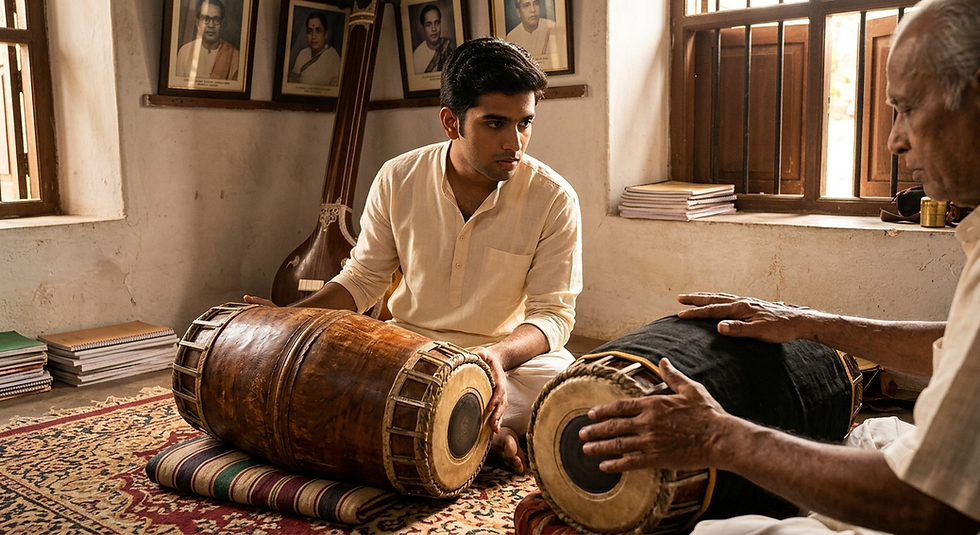
A keen student pays close attention to wrist alignment and posture. Notice how close a master's wrists stay to the leather heads on both the Valanthalai and Thoppi, and how remarkably relaxed their shoulders remain even during rapid Farans and Mohras. The exact points of finger contact are equally crucial. By watching how the fingers strike the black patch versus the outer ring, you learn how subtle shifts in angle yield entirely different tonal colors. Similarly, observing the left hand's heel pressure on the bass side reveals how smooth bass modulations and Gumki variations are executed without sacrificing balance. Slowing down performance videos to half speed can uncover these micro-movements, showing how artists transition effortlessly between strokes without raising their hands high off the drum face.
Auditory Observation: Listening with Intent
Listening as a percussionist requires a completely different mindset than listening as a casual music lover. To build a refined ear, you must train yourself to dissect the sonic landscape of a live concert rather than simply enjoying the rhythm.
Focus on the quality of Nadham, asking yourself if the Chaapu stroke rings with crisp, bell-like clarity above the soloist's pitch. Pay attention to Sowkhyam, or the sense of ease and relaxation, observing how a master maintains a steady tempo without rushing under the pressure of intricate calculations. Just as important as the notes played are the spaces in between. Observing an artist's use of Karvai reveals how intentional silence often creates far more musical impact than a barrage of continuous strokes. Finally, track the dynamic range across the concert, noticing how delicately the instrument is played during sensitive melodic passages compared to the energetic bursts of a Tani Avartanam.
Anticipation and Accompaniment Dynamics
The primary role of a mridangist is accompaniment, which demands constant visual and intuitive connection with the lead performer. By carefully observing the lead artist's body language, breathing patterns, and facial expressions, a mridangist anticipates sudden shifts in rhythm cycle or upcoming improvisations.
Maintaining a soft visual link on stage allows the percussionist to read cues for Koraippu exchanges long before they happen. Furthermore, a watchful student learns how accompaniment changes depending on the lead instrument. Playing for a vocalist demands a different density and tonal texture than accompanying a Veena, Violin, or Flute. Master percussionists don't merely mark the beat; they observe the lyrical structure and reflect its emotional weight, elevating the entire performance.
Integrating Observation into Daily Practice
Transforming observation into skill requires bringing that same sharp focus back to your own daily routine. When attending live concerts, choose seats that offer an unobstructed view of the percussionist's hands rather than focusing solely on the center stage. While watching concert recordings, practice shadow reciting through Konnakkol, synchronizing your internal rhythm with the artist's visible finger movements.
It is also invaluable to compare different Banis or stylistic traditions, noting how distinct schools approach the same rhythm structures with unique aesthetic choices. Lastly, turn the lens back onto yourself by video recording your own practice sessions. Reviewing your performance with the same analytical eye you bring to master concerts will instantly expose unnecessary physical tension, poor hand positioning, or subtle timing flaws, bridging the gap between how you sound and how you intend to sound.


Comments