
"Tani Avartanam: When Rhythm Takes Centre Stage"
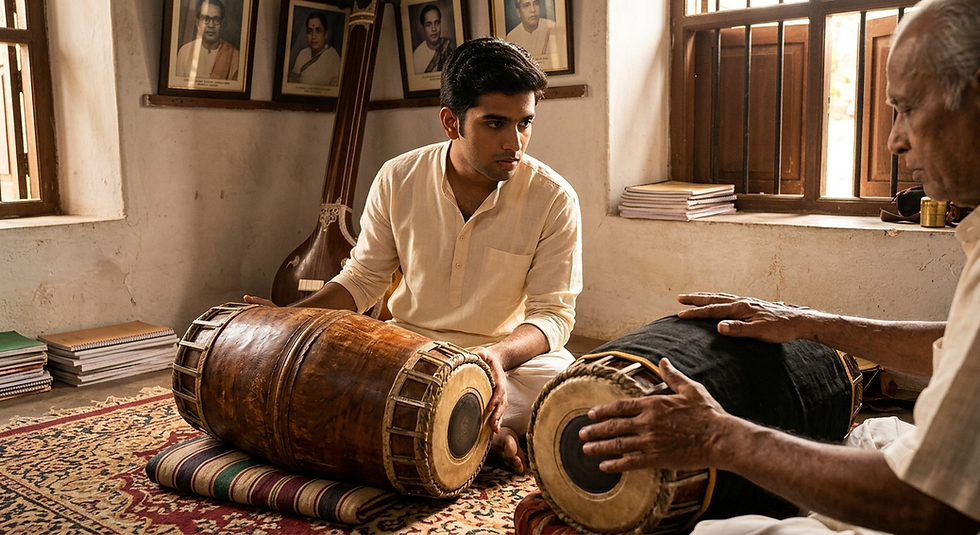
In a Carnatic music concert, the mridangam is usually heard supporting the main performer, following the melody and strengthening the rhythmic framework. But there comes a moment when the melodic instruments and vocalist step aside, and the percussion takes centre stage. This exciting section is called Tani Avartanam.
For a music learner, Tani Avartanam is much more than a mridangam solo. It is an opportunity to hear rhythm, mathematics, improvisation and creativity come together in a structured musical conversation.
What Is Tani Avartanam?
The term Tani Avartanam can be understood as a solo rhythmic presentation. It is most commonly performed by the mridangam artist during a Carnatic concert, although other percussion instruments may also participate.
During this section, the mridangam artist temporarily moves away from accompanying the main musician and presents a series of rhythmic ideas independently. The performer demonstrates control over tala, laya, nadai, patterns and improvisation, while still remaining connected to the tala of the concert.
For a beginner, it may initially sound like a rapid sequence of complicated beats. However, underneath those sounds is a carefully organised rhythmic structure.

Why Is Tani Avartanam Important?
Tani Avartanam provides the percussionist with space to demonstrate their individuality. While accompaniment requires the artist to closely follow and respond to the main performer, a solo allows greater freedom to explore rhythmic ideas.
It also gives listeners an opportunity to appreciate the mridangam as a musical instrument in its own right.
For students, listening to Tani Avartanam can help develop a deeper understanding of:
Tala and rhythmic cycles
Tempo and laya
Different nadais or rhythmic subdivisions
Solkattu
Korvais and theermanams
Improvisation
Rhythmic calculation
Coordination and listening skills
The Connection Between Tala and Tani Avartanam
One of the most important things to understand is that Tani Avartanam does not mean playing random rhythms.
The artist remains connected to a particular tala cycle. Every phrase, pause and rhythmic calculation ultimately relates back to the tala.
For example, if the concert is set in Adi Tala, the percussionist builds their presentation around that rhythmic framework. The challenge is to create interesting patterns while maintaining awareness of where each phrase fits within the tala.
This is one reason why learning to count and feel tala is essential for anyone studying mridangam.
Solkattu: Speaking the Rhythm
Before many rhythmic patterns are played, they can be expressed through solkattu, the system of spoken rhythmic syllables used in South Indian percussion.
Syllables such as tha, dhi, thom, nam and other combinations allow students to hear and understand a pattern before attempting to play it.
Solkattu is particularly valuable because it connects three things:
Thinking → Speaking → Playing
A student first understands the rhythmic idea, then speaks it, and eventually transfers that idea to the instrument.
This makes solkattu an important foundation for developing rhythmic confidence.
Exploring Nadai
Another fascinating aspect of Tani Avartanam is the exploration of nadai, which refers to the subdivision of a beat.
Students commonly encounter patterns based on four subdivisions, known as Chatusram, as well as three, five, seven and other subdivisions.
For example, a phrase may begin with a four-based rhythmic feel and later move into a five-based pattern. The change creates contrast and challenges both the performer and the listener.
Learning different nadais helps students understand how the same tala can produce very different rhythmic experiences.
The Beauty of Korvai
One of the most exciting moments in Tani Avartanam is the presentation of a korvai.
A korvai is a carefully constructed rhythmic phrase that is typically repeated three times and designed to arrive at a significant point in the tala cycle.
To a listener, a korvai may sound like a powerful rhythmic conclusion. To the performer, however, it involves careful calculation.
Students learning korvais begin to see how mathematics and musical creativity can work together. Counting becomes more than an exercise—it becomes part of musical expression.
Mora and Theermanam
Tani Avartanam also introduces learners to concepts such as mora and theermanam.
A mora involves a rhythmic idea that is presented in a structured repeated pattern, often creating a sense of anticipation before reaching an important point in the tala.
Theermanam, meanwhile, refers broadly to a rhythmic concluding phrase. These techniques help give shape and direction to the performance.
Understanding these concepts allows students to move beyond simply playing individual strokes and begin thinking in complete rhythmic phrases.
The Importance of Laya
A technically complicated pattern is not necessarily a good performance if the artist loses control of the laya.
Laya, or the sense of rhythmic tempo and flow, is central to Tani Avartanam.
The artist may gradually build intensity, move between different speeds or create complex subdivisions while maintaining an internal sense of the tala.
For students, this teaches an important lesson: speed is not the same as rhythmic skill.
Clarity, control, consistency and awareness are equally important.
Tani Avartanam as a Conversation
When more than one percussionist participates in a Tani Avartanam, the presentation can become a rhythmic conversation.
One artist may introduce an idea, while another responds to it. They may exchange patterns, explore different nadais and eventually work together toward a common rhythmic conclusion.
This teaches an important principle of Carnatic performance: music is not only about individual ability but also about listening and responding.
How Should Beginners Listen to Tani Avartanam?
At first, Tani Avartanam can seem difficult to follow. Beginners do not need to understand every calculation immediately.
Start by listening for the larger structure.
Try to identify:
The tala cycle – Can you keep the tala while listening?
The tempo – Is the artist maintaining, slowing or increasing the intensity?
The nadai – Can you hear changes in rhythmic subdivision?
The pauses – Notice how silence creates anticipation.
The endings – Listen for phrases that resolve strongly back into the tala.
With regular listening, patterns that once sounded complicated gradually begin to make sense.
How Students Can Practise
Students can begin with simple exercises rather than attempting advanced korvais immediately.
Practise keeping a steady tala while reciting simple solkattu. Once comfortable, play the same pattern on the mridangam. Gradually introduce different subdivisions and learn short korvais.
It is also useful to practise speaking before playing. If a rhythmic phrase cannot be recited clearly, it may be difficult to play it accurately.
Most importantly, practise slowly. A clean rhythmic phrase at a comfortable speed is more valuable than a fast phrase played without control.
More Than Just a Solo
Tani Avartanam represents one of the most fascinating aspects of Carnatic percussion. It combines discipline with improvisation, mathematics with musicality, and tradition with individual creativity.
For a beginner, it may start as a collection of unfamiliar sounds. But as rhythmic understanding develops, the structure behind those sounds becomes increasingly clear.
Learning to appreciate Tani Avartanam is therefore not simply about learning mridangam techniques. It is about developing an ear for rhythm, structure, anticipation and musical conversation.
The next time you hear a Carnatic concert and the mridangam takes centre stage, listen closely. Behind every stroke is a rhythmic idea, behind every phrase is a calculation, and behind every powerful ending is a deep understanding of tala.
That is the beauty of Tani Avartanam—the art of making rhythm speak.


Comments