
"How Musical Creativity Supports Innovation in STEM Fields"
Music is often introduced as an art that enriches the soul, while science and technology are seen as subjects that shape the future. Yet, these worlds are not separated by a wall—they are connected by the human mind. Every time a student learns a new composition, experiments with a rhythm, or discovers a fresh way to interpret a melody, they are strengthening the same mental abilities that drive innovation in science, technology, engineering, and mathematics (STEM).
For music learners, this means that every practice session contributes to more than musical growth. It develops a way of thinking that values observation, curiosity, experimentation, and persistence—the very qualities that lead to new discoveries across academic and professional fields.

Music Begins with Questions, Not Answers
A beginner rarely asks, "How fast can I finish this lesson?" Instead, the questions are much deeper. Why does one raga sound peaceful while another creates excitement? Why does changing a single note transform the entire mood of a melody? Why does one rhythm feel natural while another demands greater concentration?
These questions reflect a mindset of exploration rather than memorization.
Interestingly, this is exactly how scientists begin their work. They observe, ask questions, form ideas, test possibilities, and gradually arrive at answers. Music learners unknowingly practice this same habit every day by exploring sound with an open and curious mind.
Creativity Is Built Through Small Experiments
Many people imagine creativity as a sudden burst of inspiration. In reality, it usually grows through countless small experiments.
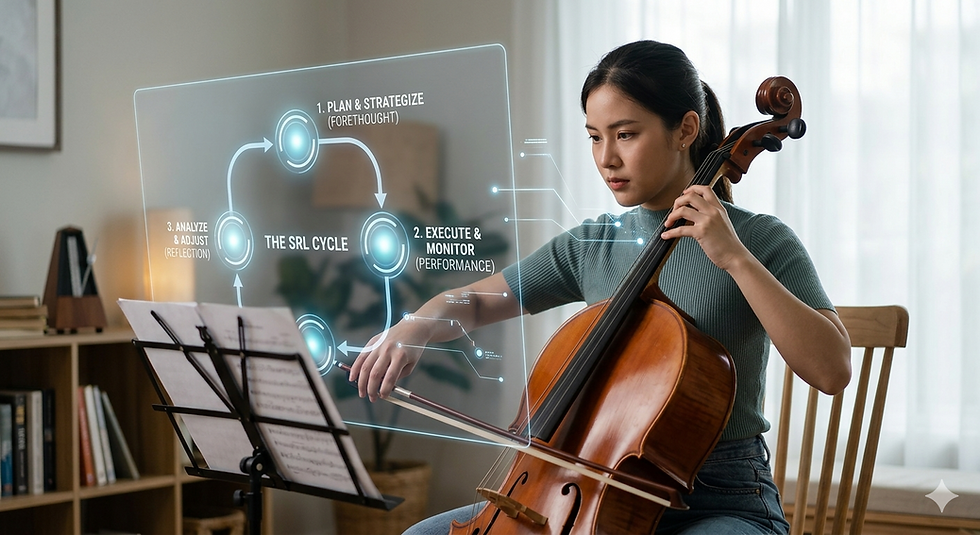
A vocalist may try different ways of presenting a phrase before finding the one that expresses the emotion most beautifully. A violinist may adjust bow pressure until the tone becomes richer. A percussion student may alter hand movements to produce greater clarity.
These tiny adjustments are experiments.
Engineers improve machines in the same manner. Programmers rewrite sections of code until software performs efficiently. Scientists refine experiments through repeated testing. Innovation is simply creativity supported by careful observation and continuous improvement—a process musicians know remarkably well.
The Courage to Make Mistakes
Music lessons quietly teach an important life principle: mistakes are part of learning.
Every missed note, broken rhythm, or forgotten lyric becomes an opportunity to improve rather than a reason to quit. Over time, students become less afraid of making errors because they understand that progress comes through correction.
This confidence becomes incredibly valuable in STEM fields, where failed experiments often lead to successful discoveries. Some of history's greatest inventions emerged after hundreds of unsuccessful attempts.
Musicians naturally develop resilience because they learn to treat mistakes as stepping stones instead of obstacles.
Listening Is an Underrated Superpower
One of the first skills developed in music is listening.
Not simply hearing sound—but listening with purpose.
A learner begins noticing subtle differences in pitch, rhythm, tempo, dynamics, and expression. Gradually, the ears become trained to detect details that others might overlook.
This habit transfers surprisingly well into academic learning.
Scientists carefully observe experimental results. Engineers notice tiny design flaws. Medical researchers detect patterns hidden within complex data. Great innovators often succeed because they notice details that others ignore.
Music develops this attentive mindset from the very beginning.
Innovation Loves Flexible Minds
Unlike subjects with a single correct answer, music often allows multiple interpretations.
Two singers can perform the same composition beautifully while expressing completely different emotions. Two instrumentalists can present identical notes with distinct musical personalities.
This teaches learners an important lesson: there can be more than one excellent solution.
Innovation depends on this flexible thinking.
Whether designing a bridge, developing an app, or solving an environmental challenge, successful innovators rarely stop at the first idea. They explore alternatives until they discover something better.
Music prepares the mind to appreciate possibilities instead of seeking only one perfect answer.
Practice Teaches Long-Term Thinking
Modern life often encourages quick results. Music encourages something different.
A difficult composition cannot be mastered overnight. A complex tala cannot be perfected in a single practice session. Even experienced performers continue refining techniques after decades of learning.
This gradual approach teaches patience.
Many scientific breakthroughs require years of research. Engineering projects often take months or even decades before completion. Students who learn music become comfortable working toward goals that require steady effort rather than immediate rewards.
Connecting Different Ideas
Music constantly combines different elements.
Pitch joins rhythm. Technique meets emotion. Theory supports creativity. Individual notes become complete musical phrases.
This habit of connecting separate ideas also appears in STEM innovation.
A robotics engineer may combine programming, electronics, and mechanical design. A biomedical researcher connects biology with artificial intelligence. Environmental scientists integrate chemistry, mathematics, and technology to solve global problems.
Music quietly trains learners to see relationships instead of isolated pieces of information.
Technology Is Expanding Musical Creativity
Today's musicians have opportunities that previous generations could only imagine. Digital recording, virtual classrooms, notation software, artificial intelligence, and interactive learning platforms have transformed how music is created and shared.
Rather than replacing creativity, technology gives musicians new tools to explore it.
Students who are comfortable with both artistic thinking and technological innovation will be prepared for careers that continue to blend these two worlds in exciting ways.
Becoming More Than a Musician
Learning music should never be viewed as an activity that exists outside academic education. It is an education in itself.
It teaches discipline without pressure, creativity without limits, observation without distraction, and confidence without comparison.
These qualities remain valuable regardless of whether a learner becomes a performer, researcher, software developer, architect, teacher, entrepreneur, or scientist.
Music does not simply prepare students for concerts.
It prepares them for complex thinking, meaningful collaboration, and lifelong learning.
Final Thoughts
The future belongs to people who can imagine new possibilities while applying knowledge with purpose. Music nurtures exactly this balance. It encourages learners to question, explore, adapt, and create—qualities that fuel innovation in every field, including STEM.
Every lesson practiced today is more than a step toward becoming a better musician. It is also an investment in becoming a more thoughtful learner, a stronger problem solver, and a more creative innovator.
The next groundbreaking engineer, scientist, or inventor may very well be the student who first discovered the joy of learning through music.


Comments