
The Smart Musician’s Guide to Bulletproof Performance
- Jun 18
- 3 min read
Updated: Jul 23
We’ve all been there. You sit down with your instrument, open your sheet music, and spend an hour playing a piece from beginning to end. You stumble at the exact same transition in measure sixteen, sigh, restart from the very beginning, and stumble all over again. An hour passes, your fingers hurt, and you feel like you’ve made zero progress. This is the trap of passive practice, and it is the fastest route to burnout. If you want to fast-track your progress, tame performance anxiety, and actually enjoy your time in the practice room, you need to unlock a concept psychologists call self-regulated learning. Don't let the academic name fool you. It simply means becoming your own ultimate music coach.
Instead of just letting practice happen to you, self-regulated learning is about taking active control of your thoughts, actions, and feelings to get the absolute most out of your time. This process works in a continuous, three-phase loop that you run through every single time you pick up your instrument.
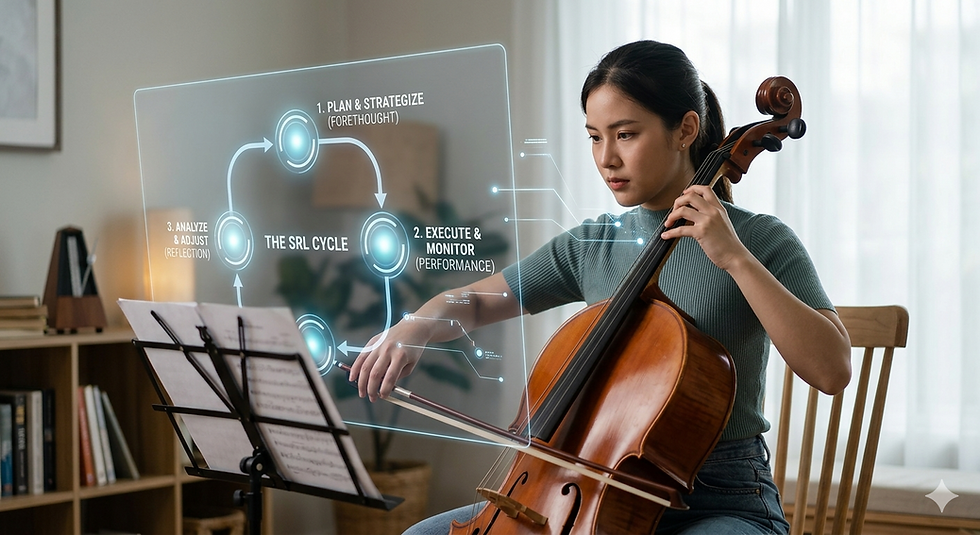
The loop begins before you even make a sound, in what is called the forethought phase. Most musicians skip this entirely, opening their instrument case and immediately launching into a song. A self-regulated learner starts with a highly specific map. Instead of aiming for a vague goal like practicing a whole movement, they decide to loop a specific four-measure jump at a slow tempo until they can play it smoothly three times in a row. They also pick a specific tactic before they start, deciding whether they will use dotted rhythms or practice the melody line entirely backward to train their brain.
Once your hands are on the instrument, you move into the performance phase. This is where you become a scientist in your own practice room by using metacognition, which is just a fancy term for thinking about your thinking. As you play, your inner coach is asking questions about your posture, shoulder tension, and the exact physical mechanics of why a certain note buzzed. You are also fiercely protecting your focus, putting your phone on do-not-disturb and actively managing your environment so your mind doesn't drift.
The final piece of the loop is the reflection phase, which happens the moment you stop playing. Instead of getting frustrated by a mistake or mindlessly repeating a error over and over, you stop to evaluate the data. You analyze whether you hit your goal, and if you didn't, you figure out why. Was it a lack of finger strength, or did you just try to play it too fast too soon? This leads to an adaptive adjustment where you change the strategy. If slow practice didn't fix a tough rhythm, an active learner switches gears to clap the rhythm away from the instrument or use a drone to check their pitch.
This shift in habits completely changes your identity as a musician. A passive practicer measures success by the kitchen timer, forcing themselves to sit in a chair for sixty minutes while hoping a piece magically gets better through repetition. A self-regulated musician measures success by micro-goals, stopping the moment a mistake happens to dissect it, and frequently recording their own playing to act as their own teacher between weekly lessons.
The ultimate magic of this mindset is that it doesn't just save you time in the practice room; it makes your stage performance bulletproof. When performance anxiety hits, it loves to fill your head with distracting thoughts about who is watching or what might go wrong. Because a self-regulated learner is highly trained in self-monitoring, they can actively command their brain to focus on task-oriented instructions instead, like keeping a wrist loose or leaning into a specific musical phrase. By taking full control of how you learn, you stop relying on luck when you walk out on stage. You know exactly what you can do, because you have mapped, analyzed, and mastered every single step of getting there.


Comments