
"The Accompanist’s Toolkit: Essential Taals for Bhajans and Ghazals"
- Jan 12
- 2 min read
While a solo Tabla recital is a display of complex mathematics and lightning speed, playing for Bhajans (devotional songs) and Light Classical music (Thumri, Dadra, Ghazal) is a completely different art form. Here, the Tabla isn't the star—it’s the heartbeat. It provides the emotional "theka" that carries the lyrics and the melody to the listener's soul.
If you are a student looking to move from practicing scales to accompanying vocalists, here is everything you need to know about the "Light" side of Tabla.
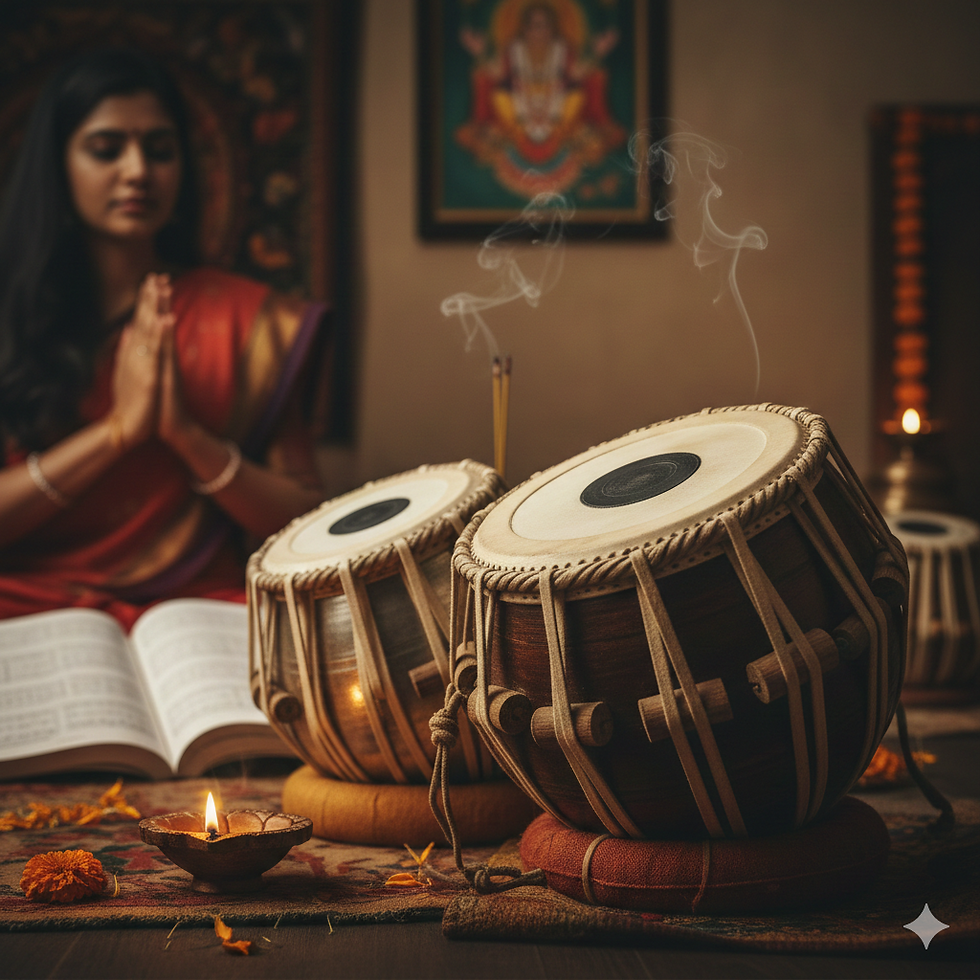
1. The "Mood" of the Rhythm
In classical music, the focus is on the Gharana and technical purity. In Bhajans, the focus is on Bhaav (emotion). Your playing must be:
Soft and Melodious: Avoid harsh, aggressive strokes.
Steady: The singer relies on you for a "cradle-like" rhythm.
Responsive: You must listen to the lyrics. If the song is about peace, your Bayan (bass) should be deep and subtle. If it’s a celebratory "Sankirtan," your Dayan (treble) can be more crisp and lively.
2. Essential Taals for Light Music
You don’t need 100 Taals for Bhajans. You need to master these four, as they cover 95% of all light music:
3. The Art of "Laggi"
In classical music, we play Kayadas and Relas. In Light Classical and Bhajans, we play Laggis.
Laggis are short, fast, repetitive patterns played at the end of a song or during a fast chorus. They add a burst of energy and excitement. Mastering the transition from a slow, steady Theka to a spirited Laggi is the hallmark of a great accompanist.
4. Key Techniques for the Accompanist
The "Walking" Bayan: In light music, the left hand (Bayan) often performs a "sliding" motion (Meend) to create a vocal-like quality.
The Mukhada (The Introduction): You need short, 1-2 beat flourishes to signal the start of a new verse.
Fillers: Learning when not to play is just as important as playing. Use small pauses to let the singer's voice shine.
Tihai: Using simple Tihais to conclude a stanza or the entire song helps the audience identify the "Sam" (the first beat) and provides a sense of completion.
5. Tips for Beginners
Listen to the Greats: Listen to how masters like Ustad Nizamuddin Khan or Pandit Anindo Chatterjee accompany Ghazals and Thumris. Notice how they "talk" to the singer.
Practice with a Tanpura: Don't just practice with a metronome. A Tanpura app will help you tune your Tabla to the melody, which is crucial for light music.
Learn the Lyrics: If you know when the "Antara" (verse) is coming, you can prepare your rhythmic transitions accordingly.
Conclusion
Playing Tabla for Bhajans is a spiritual experience. It requires humility, a keen ear, and a steady hand. When the rhythm and the lyrics merge perfectly, the music becomes more than just sound—it becomes a meditation.


Comments