
"Syllable Science: The Secret to Clean Mridangam Strokes"
- May 4
- 3 min read
When you first sit down with a Mridangam, you aren't just playing a drum; you’re engaging with a tradition that treats percussion as a melodic science. To really get a handle on syllable exercises, you have to look at them as the physical vocabulary for your hands.
Here is a deep dive into the exercises and the "human" side of practicing this instrument.

The Fundamental Soundscapes
Before you even think about rhythm, you have to find the "soul" of each stroke. The Mridangam is a dual-headed instrument, and each side has a completely different personality.
The Valanthalai (Right Side): This is where the melody lives. The black center (Karanai) is sensitive. When you play Dhi, you use your middle and ring fingers to strike the center while keeping them there for a split second to "choke" the sound. When you play Nam, you hit the outer rim with your index finger, letting it ring out like a bell.
The Thoppi (Left Side): This is the bass. Tha is a flat, muted palm strike that grounds the rhythm. Thom, however, is the resonant bass. You strike the skin and immediately pull your hand away to let the low frequency bloom.
Step 1: The "Sarvalagu" Foundation
In Carnatic music, Sarvalagu refers to a steady, flowing beat that feels natural and effortless.
The Exercise: Tha - Dhi - Thom - Nam
Practice this in a loop. The goal isn't just to hit the notes, but to make sure the volume is consistent across all four strokes. A common mistake is making the left-hand strokes much louder than the right-hand ones.
Level 1: One stroke per beat. Focus on your posture.
Level 2: Two strokes per beat. Start feeling the "bounce" in your wrist.
Level 3: Four strokes per beat. This is where your fingers start to feel the "burn."
Step 2: Developing Finger Independence (The Ki-Ta-Ka Factor)
As you progress, you'll notice that the Mridangam requires your fingers to act like independent hammers. The syllables Ki, Ta, and Ka are designed to train this.
Exercise: Tha - Ki - Ta - Ka
Tha: Right hand (rim)
Ki: Left hand (bass)
Ta: Right hand (center)
Ka: Left hand (bass)
This "cross-talking" between your hands is what builds the neural pathways for complex accompaniment. If you can play this pattern smoothly at a high speed, you’ve unlocked the door to professional-level playing.
Step 3: The Secret to Speed (The "Dhina" Roll)
Everyone wants to play fast, but speed on a Mridangam comes from relaxation, not force. The Dhi-Na roll is how you achieve that continuous, machine-gun-like sound.
Instead of moving your whole arm, you use a "seesaw" motion with your right wrist. Your middle fingers hit the center (Dhi) and then your index finger strikes the rim (Na).
The Drill: Play Dhi-Na-Dhi-Na for five minutes straight without stopping.
The Goal: It should sound like a steady stream of water, with no gaps or stumbles.
The "Hidden" Aspects of Practice
If you talk to any seasoned player, they’ll tell you that what happens away from the drum is just as important as what happens on it.
Konnakol (Vocal Percussion): You must be able to recite these exercises perfectly before you play them. If your tongue trips over the syllables, your fingers definitely will. Reciting them helps you internalize the Laya (rhythm) without getting distracted by the physical difficulty of the drum.
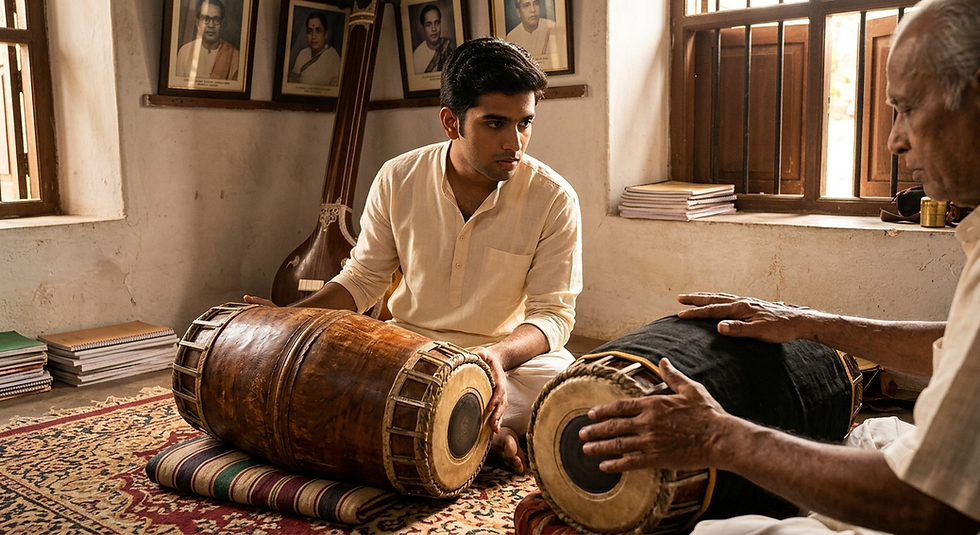
Listening and Observation: Spend time watching how a master's hands look. They often look like they aren't even trying. That "effortless" look is the result of years of removing tension from their shoulders and wrists.
Tuning as an Exercise: Part of learning the syllables is learning the pitch. If your Mridangam isn't tuned perfectly to the Adhara Shadjam (tonic note), your Nam won't sing correctly, and you'll subconsciously play harder to compensate. Learning to tune with your tuning stone is an exercise in itself.
A Final Thought for the Learner
The Mridangam is a demanding teacher. There will be days when your fingers feel like lead and your Thom sounds muddy. That’s okay. This instrument is about the relationship between your body and the wood and leather. Respect the process, keep your strokes clean, and eventually, the drum will start speaking for you.


Comments