
"From Practice to Presence: Living the Bandish "Prabhu Mohe Bharosa"
Hindustani classical music is far more than a structured exercise in memorizing swaras and tracking taals—it is fundamentally the art of translating deep human emotion into a physical, acoustic experience. The traditional bandish "Prabhu Mohe Bharosa Ek Tiharo" set in Raag Jaunpuri serves as a quintessential masterclass in this philosophy, demonstrating how melodic architecture and devotional sentiment can seamlessly interlock. With poetic lyrics that voice absolute surrender and unflinching faith in the Divine, this composition offers music learners a profound learning experience: the opportunity to bridge technical vocal discipline with authentic bhava (emotional resonance).
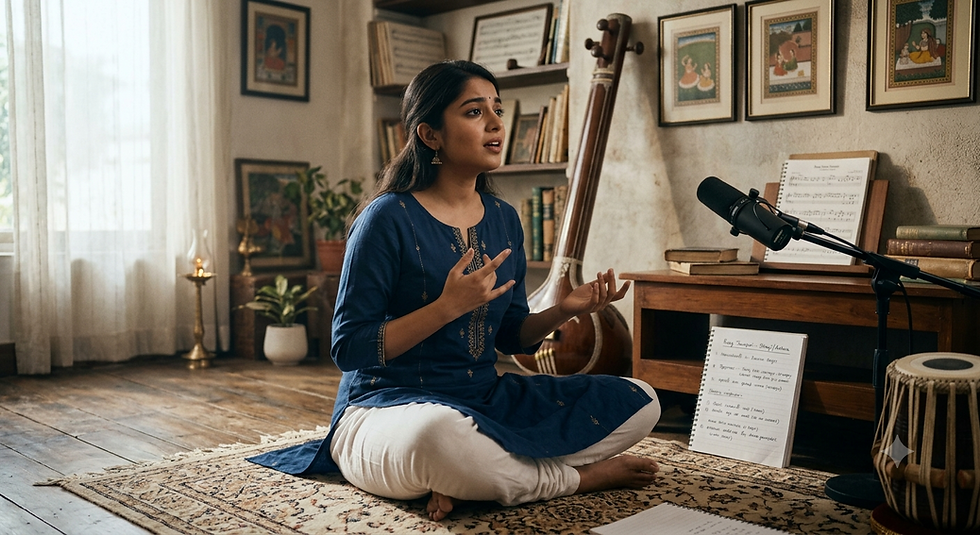
Raag Jaunpuri itself possesses a distinct and compelling melodic personality—it is introspective, regal, deeply devotional, and imbued with a delicate shade of longing. As a morning raag belonging to the Asavari thaat, its characteristic meends (glides) and intricate phrase movements create a rich, somber atmosphere that forms the ideal backdrop for a sacred text. When approaching this bandish, learners are encouraged to look beyond pitch names and view the composition as an unfolding musical narrative. Rather than attempting to digest the entire piece at once, the most effective approach is to divide the Sthayi and Antara into manageable, bite-sized micro-phrases. Practicing each phrase slowly and with intense focus builds sharp swara-sthana (pitch precision), develops better breath control, and ensures proper linguistic diction. This process is heavily reinforced by active listening; absorbing a teacher's rendition repeatedly trains the student's ear to pick up on critical nuances—such as gentle micro-tonal inflections, delicate pauses, and the graceful movement required to approach the primary notes.
Equally important in mastering this piece is developing a natural, unforced relationship with its rhythmic frame, Teentaal—a 16-beat cycle widely used across classical compositions. For developing vocalists, holding onto emotional vulnerability while mentally keeping time can feel overwhelming, often leading to a mechanical performance where counting beats takes precedence over expression. To overcome this hurdle, learners should temporarily decouple rhythm from melody. Practicing bol-pat (reciting the text rhythmically) while physically marking the structure of Teentaal—clapping on the Sam (1st beat) and Talis (5th and 13th beats), and waving on the Khali (9th beat)—builds an internal metronome. Over time, this deliberate practice transforms conscious counting into subconscious intuition; the vocalist stops calculating beat numbers and instead begins to feel the natural gravitational pull toward the Sam, allowing the music to flow effortlessly within the meter.
Because "Prabhu Mohe Bharosa Ek Tiharo" is fundamentally a prayer, the treatment of language plays a central role in its execution. The emotional impact of Hindustani vocal music relies heavily on the principle of sahajta (naturalness)—the idea that words should never be rushed, distorted, or clipped merely to squeeze them into a tight musical cadence. Instead, the inherent rhythm and cadence of the lyrics must be respected, allowing the words to marry the swaras organically. Understanding the underlying meaning of the composition—a humble plea declaring that one's ultimate reliance rests solely with the Creator—naturally alters how a singer approaches the notes. The voice softens, the dynamics adjust, and the performance transforms from a mere technical exercise into a genuine, heartfelt expression.
Ultimately, "Prabhu Mohe Bharosa Ek Tiharo" stands as a complete, multi-dimensional training ground for vocal students. It synthesizes pitch accuracy, rhythmic stability, poetic sensitivity, ear training, and expressive depth into a single, cohesive piece. As the foundational mechanics become second nature, the student's focus naturally evolves from basic memorization to artistic interpretation. One begins to notice how the descending phrases mirror the posture of surrender, and how the subtle weight placed on the Komal Dhaivat (underline D) and Komal Gandhar (underline G) unlocks the true soul of Raag Jaunpuri. Approached with patience, regular practice, and guidance, this bandish ceases to be just another entry in a music student's notebook—it becomes a transformative doorway into understanding how Hindustani classical music elevates human devotion into timeless art.


Comments