
"Mezrab Magic: How to Turn Your Mallets into an Extension of Your Soul"
- 8 hours ago
- 3 min read
If you’ve ever watched a Santoor maestro like Pandit Shivkumar Sharma or Rahul Sharma, you know the visual is as captivating as the sound. Their hands dance over 100 strings with lightning speed, wielding two delicate, curved wooden sticks.
These aren't just "sticks"—they are the Mezrab (the mallets), and they are the heart of the Santoor. For a music learner, understanding the Mezrab is the bridge between simply "hitting strings" and creating a soulful melody.
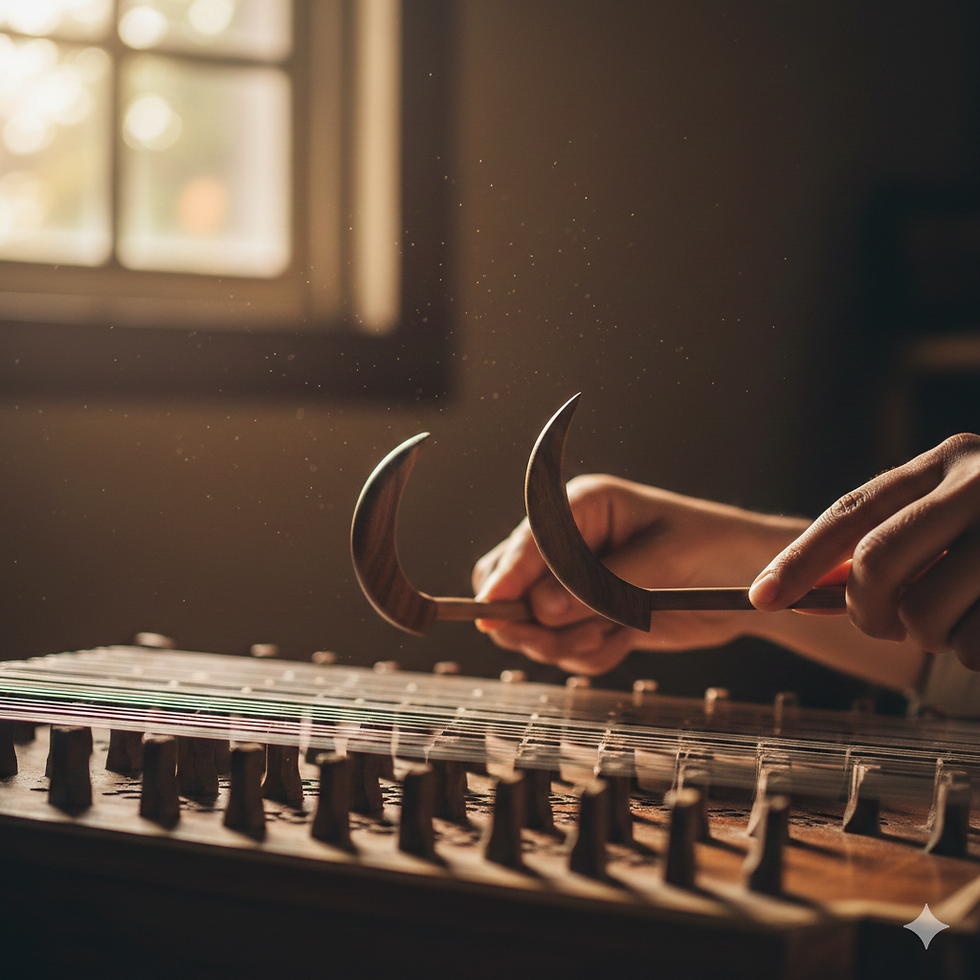
What Exactly is a Mezrab?
The word Mezrab (sometimes called Kalam in Kashmiri tradition) refers to the strikers used to play the instrument. Unlike a piano, where a felt hammer hits a string inside a box, the Santoor player interacts directly with the strings using these handcrafted tools.
The Material: Usually carved from Walnut or Rosewood. The wood must be lightweight for speed, yet dense enough to produce a bright, percussive "clink."
The Shape: They are curved like a pair of gentle horns or a crescent moon. This unique curvature is essential for the "flick" of the wrist.
The Tip: The striking end is slightly weighted to ensure the string vibrates clearly upon contact.
The Anatomy of the Grip
The most common mistake beginners make is gripping the Mezrab like a hammer. In Indian Classical music, the grip is a delicate balance of firmness and fluidity.
Finger Placement: The Mezrab is typically held between the index finger, middle finger, and thumb.
The Pivot Point: You don't play from the elbow or the shoulder. All the power and nuance come from the wrist. Think of it as a controlled bounce—the mallet hits the string and must retract instantly to let the note breathe.
Essential Techniques: Beyond the Strike
Mastering the Mezrab isn't just about hitting the right note; it’s about how you hit it.
1. The Single Stroke (Bol)
The fundamental strike. It must be clean, hitting only the intended pair of strings. If you linger too long on the string, you "dampen" the sound, resulting in a dull thud.
2. The Tremolo (Glitters)
Because the Santoor is a staccato instrument (the sound dies out quickly), players use a rapid back-and-forth striking technique called Tremolo. This creates a continuous, flowing sound that gives the Santoor its iconic "shimmering" or "waterfall" quality.
3. The Glissando (Simulating Meend)
Indian music relies heavily on Meend (the glide between notes). Since the Santoor's strings are fixed, players simulate this by sliding the Mezrab across the strings or using a delicate "bouncing" motion to create a melodic curve.
Pro-Tips for Beginners
Balance is Key: Ensure your left and right Mezrabs are identical in weight. A heavier left mallet will make your rhythm sound lopsided.
Relax Your Wrists: Tension is the enemy of speed. If your forearm hurts after five minutes, your grip is too tight.
Practice "Silent" Striking: Try practicing the motion on a flat table before moving to the strings. Listen for a consistent "tap" to ensure your rhythm is steady.
The Connection
The Mezrab is an extension of your nervous system. When you play, you aren't just striking wire; you are sending a pulse of energy through the wood into the instrument. Treat your mallets with care—keep them dry, smooth, and always stored in a protective case!


Comments